Showing posts with label mine workers. Show all posts

Sunday, February 25, 2024

Reflecting on Catherine Young's book "Black Diamonds: A Childhood Colored by Coal"

Black Diamonds: A Childhood Colored by Coal by Catherine Young
Torrey House Press
Published: 09/26/2023
Pages: 288
ISBN: 9781948814836
$17.95 paperback


The Lackawanna Valley is a c. 1855 painting by the American artist George Inness


Catherine Young has written a marvelous "personal geography" out of her raw experiences growing up in Scranton, Pennsylvania in the final years of anthracite coal mining and manufacturing in Northeastern Pennsylvania (NEPA). As she says in her Afterword, "...the story connects humanity's choices around the globe. I wrote it to honor a people and a history I felt had become lost, and I wrote it as a way of understanding the choices before us."

Young uses the painting above as her point of departure and gives readers a child's perceptions of life in Scranton, then near the northern tip of the active anthracite coal fields. The book is filled with the innocent questions children ask and the answers given by adults and the memories of walking with her parents through her hollow and through downtown Scranton as the city fell apart. She recalls smells, tastes, sounds and other sensations with complete accuracy. She gives a tragic and stunning account of trying unsuccessfully as an eight-year-old to save her father's life, but this loss of a parent does not stand alone as the book's saddest moment because there is so much other loss recorded here: the insults of people not from the region directed at the people who live there, the loss of civil society and jobs, the loss of a familiar environment, the loss and altering of the region's environment for mining and railroads and highways, and Young's leaving the region as a young adult.

I know a good deal about what Young has recorded because my father's family lived in the Hazleton area, about one hour south of Scranton. She and I are about the same, age, I think, and I expected in my teenage and young adult years to live in the area, work in the mines or factories there, and retire and die there and be buried alonside of my relatives in a quiet cemetery in Weston. It didn't work out that way for me, but I clearly remember the smells, sounds and tastes that Young describes.

Young is absolutely correct when she writes about the mass depression and hopelessness that has taken hold in NEPA. That grim lack of hope likely set in during the early years of the 20th century and deepened over the decades. The region has been exploited by the coal and manufacturing companies and crooked politicians, wounded by union failures, beset by environmental crises that seem irreversible, and has more recently has been overwhelmed by drugs. These are Appalachia's special and concentrated on-going crises that take the intense forms that they do because mining and industrial Appalachia has functioned as a kind of "internal colony" within the United States. Anthracite is hardly used these days and the union-represented garment, textile and other industrial manufacturing are mostly gone and so the region is neglected and impoverished.

New immigrant labor in the region is exploited and faces discrimination not only from employers and political institutions, but from many of the descendents of the immigrants who worked in the mines and mills and who have been stuck there and whose lives are only marginally better than those of the new immigrants if they are better at all. The insularity and clannishness that Appalachia is known and harshly ridiculed for can be both a commonsense response to outsiders who often bring harm to the region and who also often disguise themselves as friends who are trying to help, but it can also be  means of dividing people who objectively share long-range interests. Paul Shackels' new book Ruined Anthracite: Historical Trauma in Coal-Mining Communities gives an excellent overview of these conditions and can be read along with Young's book.


Culm Bank in Beaver Brook, Pennsylvania, 2018. Credit: Paul Shackel


Young's book is filled with endearing recollections and tougher reflections that slowly and carefully build on one another in order to give readers an understanding of how values and world views were transmitted from adults to children in the anthracite region. The region was simply known as "The Anthracite" when I was young, and as the author points out the coal was "our coal" and people felt a defensive pride in their communities. "When all is still, when we're upstairs lying on our beds, we'll hear the coal trains rumble upgrade," Young says, "We know who we are. It's our coal on those treains. Our coal. Our fuel to burn."

 Young also remembers visiting a cemetery and says

Spread across the hill in small clusters, the gravestones mark households, naming those who lived together and leave spaces for those who will join them. Here we trace our names incised in gray granite. Our names: first and last, passed on to us. These are our uncles, aunties, and cousins in this fenced-in yard. They laid rails, blasted coal, opened doors to mines. They hauled and shoveled coal, and drank hard to blur hard living. Their hands pounded bread dough, watched it rise to pound again. They held their children in the night, feverish from influenza, dying from diphtheria.. And now they all lie, side-by-side, tiny headstones clustered behind large ones.

On this hillside the dead sleep. I imagine that their dreams drift down with the waters, float beneath the plank bridge, and past the tunnel. The quiet dances with the breeze that stirs and shakes the ribbons hung at each gravesite; the brook rolls over stones endlessly shushing, shushing.

But a train comes, breaking the stillness and the voice of the brook...


An aunt, a great-grandmother, my grandmother, and my grandfather.  

Young also tackles how we came to understand something of our pasts, our relations, and Americanization in The Anthracite when she recalls her childhood confusion over when to use "Zi'" and when to use "Aunt" and "Uncle." The Italian words for "Aunt" and "Uncle" ---in my family they were "Zia" and "Zio"---were reserved for people born in The Old Country and the American words were used for relations born here, but these words were also used imprecisely. My Great Aunt Emma remains Zia Emma because she was born in The Old Country, but my Great Aunts Pally (Celeste) and Catherine were Aunt Pally and Aunt Catherine because they were born here. People we had no blood relationships with who were born here might also be called "Aunt Rita" or "Aunt Doris."

Young's memories and mine diverge on a few points, but I realize that the Hazleton area was different from Scranton in some respects despite their proximity and I trust her memory more than my own. She did not see photos of breaker boys as a child, but I certainly did. I don't remember coal trains hauling anthracite coal. Young says

It wasn't bad enough that our valley began emptying of people during the Great Depression and never stopped, or that the land was black while the rivers ran orange. It wasn't enough that smoke rose from the burning piles of waste coal lining the length of the Lackawanna River, and below ground, the mines caught fire. The air we breathed day and night was smoke-filled and reeked of the rotten-egg sulfur smell. The ornate nineteenth-century buildings, our fabulous city architecture, crumbled or mysteriously burned down. Around us everywhere were ill and unemployed miners, machinists, and factory workers. Sanatoriums topped the mountains---refuges for the wealthier members of the community with lung disease to escape the smoke for a while. Twice yearly, the Turberculosis Society van with its heavy x-ray equipment parked in front of our schools. We children entered it, and one by one splayed our chests on the screen to find out who among us were the next victims.    


Breaker boys

While thinking about the differences between Hazleton and Scranton I recalled meeting a man in a church in Baltimore from Hazleton many years ago. I had guessed that many people from The Anthracite attended that church and I wasn't wrong. The man was telling me about his wife and mentioned that she was from Scranton. He then said somewhat wistfully, "Imagine that! A girl from up in the Valley would marry a guy from Hazleton! No one thought that it work out, but it did." The man and his wife belonged to the same ethnic group, attended the same church, and were both blue-collar people, but something still separated their communities.

I want to make three concluding observations here. Whether they intended to or not, it seems to me that the adults in the book were preparing Young for an adult life outside of the region. They often encouraged her childhood curiosity and intellct and they gave her the tools needed to succeed. Young implies this, I think, but she doesn't tell readers if this was the case or not. Second, I think that Young and I share the angst or survivor's guilt that comes with having left the region. There is much in the book about how she left, but there is less about why she left and about why she does not return.

Last, near the end of the book Young provides something like a land acknowledgement that mentions the Lenape people who were forced out of the region by white settlers and colonialism. This is welcome, and it could have gone into greater and deeper detail, but something else comes to my mind here as well. Today across much of Appalachia children will show up for holiday and other social events and go for the candy and presents or prizes, but it happens frequently that they also check to see where the Narcan is for the adults with them. "Look, Grandma, the Narcan is there!" you might hear a five-year-old shout. Young does a great job when she contrasts where she now lives in the Midwest with The Anthracite and when she recalls how people not from the region can be callous when they think about the region and our people. That critique is a necessary part of the story, but time is moving on and we have to see this new development as well. It is not only about mournig what we have lost and about defensively protecting our cherished memories and people, but also about seeing the next step being taken in the region's alienation and fighting back. 


Note: Thanks to Charlie Stephens of Sea Wolf Books for recomending this book. Please see the Sea Wolf Books website for a list of their classes and retreats and to order books.  

Wednesday, January 25, 2023

The United Mine Workers of America was founded on this date in 1890

The United Mine Workers of America (UMWA) was founded in Columbus, Ohio on January 25, 1890. The union was founded by people who came from different coalfields and from different traditions of mine worker unionism. Many attempts had ben made to form local, regional, and national unions of mine workers, and there had been notable successes and failures in organizing the coal miners. The methods of mining coal and the structures of the anthracite and bituminous coal industries were changing as coal was helping to drive the expansion of modern capitalist industry. Competition between mining districts and between the coal operators and changes in the methods of extracting coal tended to drive wages down and makes mining ever more dangerous.

The UMWA sought to achieve industrial stability in coal mining from the union's earliest days. In the best light, this meant restricting competition between the operators and winning legislation that restricted or outlawed child labor, defined what a legal ton of coal was, required safe mining practices and workplace safety, insured mine workers' safety and health, and provided for mine workers after they were too old or infirmed to work. In the early days the union and the coal operators sought to reach agreement on coal prices together and to use their relative power to control coal markets together. But the operators were never good partners to the union, and competition from non-union and low-cost mining districts and industrial monopolization worked against union-operator cooperation. Industrial chaos was always just a half-step away. Under these conditions, then, the union and the operators came to represent different and opposing interests.

In the worst light, local and district unions competed with one another and the union's leadership played union locals and districts against one another. The leadership sometimes sought to partner with certain operators and politicians in ways that were at least unethical and that did not always serve the worker's long-term interests. Corrupt union officials have done much damage to the union's cause and reputation. The union was sometimes fighting for industrial stability on its own. Mine workers often looked first at their mine, then at their company or region, and then, perhaps, at the national picture when it came to union affairs and deciding union policies and voting on union contracts. Changes in mining technology worked against the mine workers maintaining employment and solidarity and keeping control of their work, and resentments have grown from this. The noble attempts by the union to win industry-wide contracts and to create a working pension system and to provide for healthcare have depended on extending union organizing, stable employment, payments made by union-represented coal operators, industrial stability, fair courts, and cooperation and support from state and federal officials. Only at rare moment in our history have most of these factors been in place at the same moment.

It is a miracle and a blessing that the UMWA still exists. The coal operators and their allies have sought to divide the mine workers and have used their economic and political power to isolate the workers and break the union. They have brought extraordinary pressure to bear against the union and have used violence when that suited their needs. They have influenced the public schools and other public institutions in many areas to be "pro-coal," which has come to mean pro-company, and the true history of mine workers' struggles has to be constantly rescued from their hands.

The union remains the only reasonable and available institution to represent mine workers' interests. There are about 67,000 coal mine workers in the United States and Canada, and the UMWA may represent something just over 20 percent of those workers. According to the union's website, the UMWA now represents "coal miners, manufacturing workers, clean coal technicians, health care workers, corrections officers and public employees throughout the United States and Canada." Not too many years ago the union had the slogan that "God, guns and guts built the UMWA" and I believe that that has been true. The UMWA has set a high bar for other unions and has used its power to support other unions. The idea that strikers have to "last one day longer" and our modern concepts of industrial unionism come from the UMWA to a great extent. Today the union depends more on God and guts and its ability to make its case to workers and its power to win good contracts.

We need a new era of union organizing to boost the union's numbers and influence and power so that mine workers do better and so that their communities survive. Good living wages and retirement benefits, guaranteed by a union contract, circulate through mining communities quickly and raise everyone's standards of living. A progressive wage floor, strong health and safety provisions with active enforcement, and protected pension plans in coal mining benefit all workers and our communities no matter what jobs we have or where we live. 

The pictures and music below come from a variety of sources and are posted here to show readers something of mine workers and mining communities. I am including some of my own narratives and commentary by others. Not all of the workers and mines here are union-represented. My point is to create a context for understanding where the UMWA comes from and why the union is needed now.

The best resource there is the United Mine Workers of America website. One of the best things that you can do right now is to support the striking Warrior Met mine workers in Alabama. They have been on strike for over 21 months. Go right here to do that. Another great resource for learning union history is the West Virginia Mine Wars Museum. The Mother Jones Museum is also a great resource.


New Salem Baptist Church

Built in 1921 for the African American community of Tams, West Virginia. The New Salem Baptist Church is one of the last remaining structures in Tams. At one time the church boasted a congregation of around 350, but those numbers have dwindled to about a dozen since the mine closed in 1955. The last residents of the town of Tams vacated in the 1980s and the remaining structures were destroyed or moved. Photograph and text by David Dunlap, courtesy of Broken Doors Photography and Art Collective


A snapshot of War, West Virginia.

Incorporated in 1920, War was previously known as Miner's City. At its height War had almost 4,000 residents, a far cry from the approximately 690 as of the 2020 census. Photo and text by David Dunlap, courtesy of Broken Doors Photography and Art Collective


Blue Diamond Mines--The Johnson Mountain Boys


1973


An anthracite miner and his wife


A coal mining community and family in Utah


Women gathering coal in the Pennsylvania anthracite region.


Photograph by Kristen Kennedy of Virginia Lee Photography. She is one
 of my favorite modern photographers and her work has appeared on this blog many times.


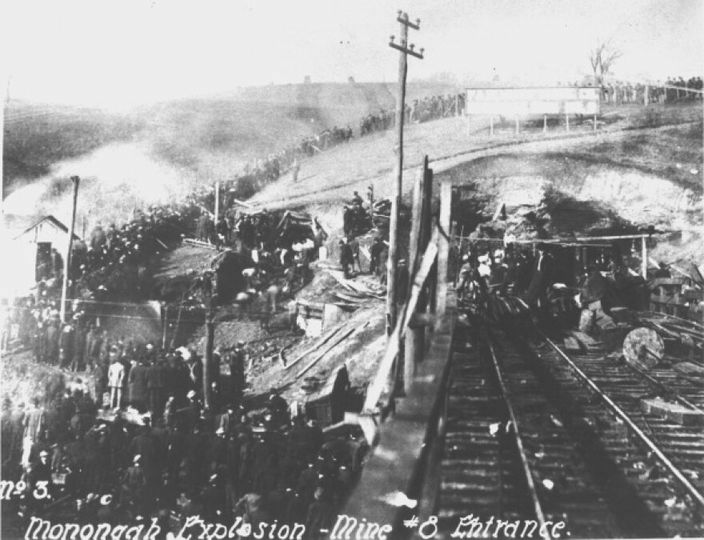
The Monongah Mine Disaster of December 6, 1907 took the lives of at least 362 mine 
workers, many of them immigrants. It was the worst disaster in coal mining history in
the United States.


"The coal you mine is not Slavic coal. It's not Irish coal. It's not Polish coal. It's not 
Italian coal. It's coal."---John Mitchell, President of the UMWA 1898-1908


Around the time that Arnold Miller was becoming nationally known I decided that I would
go to work in the mines as some of my great uncles and others in my extended family had done. I was close to dropping out of school, and working in the mines was all that I could see myself doing. My father, who knew the miner's life, and I had quite an argument about it. The argument ended with me saying arrogantly "I'm going to work in the mines!" and my father saying, "Just stay where you are. I'm going to go find a heavy object and kill you and save the company the trouble." I waited until after my father passed on to get my mining papers.


On April 20, 1914 Colorado National Guard troops opened fire on the Ludlow tent colony in Ludlow, Colorado. Striking mine workers and their families were living in the tent colony during one of the most dramatic and heart-wrenching strikes in U.S. history. At least 19 people, including 12 children and 2 women who were associated with the strikers and the union, died that day at Ludlow. This is a photograph of the Ludlow Massacre memorial.


Nimrod Workman - Forty-Two Years (1976)


Afterword

The "Blue Diamond Mines" song may seem like an odd choice to open this post with, but I believe that it captures a feeling of a place and time and allows me to say something about mine workers' cultures. There are plenty of complaints made by mine workers about the union, but in my experience these are complaints about policies or personalities more than anything else, and they're often made from a place of love and hope. Dissent was baked into the union when it was founded in 1890.

I believe that I owe the UMWA for almost everything that I have today, and I feel good about paying my associate dues every year. How and why I'm paying associate dues instead of retired dues is a long story, but life has its twists and turns. I feel especially good when I can support the Black Lung Movement. I'm thankful every day that I have known so many mine workers, had them as friends and family, joined those picket lines, shared time and food and memories with them and their families. They blessed me with their wisdom and humor, blessings that I have not deserved. Regardless of what you think about coal and energy sources and climate change, I'm sure that you believe that mine workers should receive decent pay and benefits and have secure healthcare and retirement systems. I'm sure that you believe in workplace safety and health. I'm certain that you believe that coal communities and former coal communities should not be abandoned and left to fend for themselves.

Please support those Warrior Met strikers. Please support the miner's rights to a fair standard of working and living, to dignity in retirement and to healthcare. Please support the coal mining and former coal mining communities.

Tuesday, January 17, 2023

Hazel Dickens


The Hazel Dickens Memorial Bridge is on County Route 11 running over the Bluestone River near Montcalm, West Virginia.


She is buried in Princeton, West Virginia.


She lit up my life and the lives of so many others. I really do miss her.


West Virginia My Home


Beautiful Hills Of Galilee


They'll Never Keep Us Down

Friday, January 13, 2023

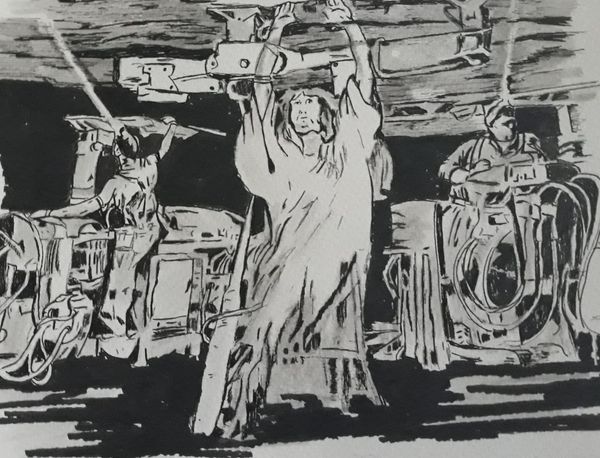
The beauty within us and around us---some sketches by Ms. Debra Lynn Kimball

These sketches were done by Debra Lynn Kimball. She is a retiree living in West Virginia and doe some great art work. These sketches depict Christ in the mines watching over mine workers. I think that most people who go underground for work pray some, and many mine workers will tell you that they either
depend on God's protection or have been saved from disasters underground by divine intervention or know people who have been. There can be a spirituality attached to the work, and I think that Ms. Kimball's great sketch work captures some of that.

I want to offer one more thought here. I'm one of those people who loves mine workers and mining communities, but that does not mean that I love the coal industry and do not want to see needed economic and political transitions take place. That said, I want to ask people who don't think much about the mine workers and their communities, and those who do think about them through the lenses of stereotypes, to consider that no one is going to give up on work that they pray over and have a spiritual attachment to without something better and safer and guaranteed and that they can take ownership of in the same ways that mine workers feel ownership and control of their work.


This is part of a blog series on the beautiful things around us and within us. I enjoy doing these posts more than many others. To see other posts in this series, please hit the "Beauty" tag on this post. Thanks!

Wednesday, January 11, 2023

One woman who worked in the mines


This photograph was taken in 1979, and I believe that it appeared in the Mountain Life & Work magazine. That was a progressive or radical magazine at the time that did much to help build peoples' power and workers' power in Appalachia. Linda King had worked in a garment factory in Virginia for a time but then became a roof bolter's helper or a roof bolter at the Bullitt Mine in Big Stone Gap, Virginia.

Tuesday, January 10, 2023

Some commentary on what happened to Damar Hamlin and shared interests

In my world what happened to Damar Hamlin and the role of the players and the NFL Players Association in taking righteous on-the-spot action to end the game on January 2 has loomed extra-large. There have been many strong commentaries on what happened, and Damar Hamlin's gradual recovery is rightfully being cheered on. One of the better commentaries has come from Garrett Bush, who does the Ultimate Cleveland Sports Show. Mr. Bush speaks with prophetic energy.

If you are tracking the context for what happened to Damar Hamlin, please go here to hear Robin Young of National Public Radio speak with Mr. Bush and to catch a great clip of Mr. Bush on his show.

It is hard for me to tell what Mr. Bush thinks of the Players Association from these clips. I support the Association and all unions, and I hope that we all have the bandwidth to understand that the players and their union took direct action and closed down the game on January 2 and that that took courage on their part. It also sets a great example for all workers and for all unions. I don't hear fans faulting the platers, so it's a safe gamble that what did has mass support.

I think that Mr. Bush makes a strong point in his interview with Robin Young when he talks about coal miners, football players, and Black Lung (see here and here). We all have this tendency to think of sports figures as living and working in another universe, apart from the rest of the working-class. Mr. Bush goes in another direction and shows how the players need to understand the experiences of blue-collar workers, and especially coal miners, and how the work done by the players increasingly feels like blue-collar work to them. This opens a box full of possibilities. Shared experiences create shared interests and shared interests can create powerful movements for social change.

What Mr. Bush does not say---and he may not be aware of this---is that the numbers of people suffering with Black Lung are increasing and the average age for a mine worker with Black Lung is dropping. Why is this so? The nature of coal mining work and the methods used in mining are changing somewhat. The coal mining industry is doing relatively well, but workers are still near the end of the line when it comes to benefitting from this. The most important factor in this in my mind is the loss of union representation in many mining districts. And that loss of union representation in mining should concern everyone.

Mr. Bush makes strong points about the precedents set by miners getting Black Lung benefits and better safety conditions in the mines over time but his data is a little old and the benefits and safety conditions must improve. But both the NFL Players and coal miners have taken strong actions to protest their working conditions. Work safety conditions and coverage for injured nd disabled workers must improve  so all workers---all of us---can do better. He still has a strong argument, and he's going in the right direction, but we all need to lend a hand and build solidarity. 


Sunday, January 8, 2023

The beauty around us and within us

I'm going to enter this as part of our blog series on the beautiful things among and around us. This collage was done by Mr. Mark Hanna. I would not have known that it was a collage had I not been told. The detail and the faces are extraordinary and true to life. Mr. Hanna lives somewhere in Appalachia. He calls this "We will keep a light on for you." Wonderful!


You can see more in this series by hitting the "Beauty" tag below.