Showing posts with label Justice. Show all posts

Wednesday, January 25, 2023

The United Mine Workers of America was founded on this date in 1890

The United Mine Workers of America (UMWA) was founded in Columbus, Ohio on January 25, 1890. The union was founded by people who came from different coalfields and from different traditions of mine worker unionism. Many attempts had ben made to form local, regional, and national unions of mine workers, and there had been notable successes and failures in organizing the coal miners. The methods of mining coal and the structures of the anthracite and bituminous coal industries were changing as coal was helping to drive the expansion of modern capitalist industry. Competition between mining districts and between the coal operators and changes in the methods of extracting coal tended to drive wages down and makes mining ever more dangerous.

The UMWA sought to achieve industrial stability in coal mining from the union's earliest days. In the best light, this meant restricting competition between the operators and winning legislation that restricted or outlawed child labor, defined what a legal ton of coal was, required safe mining practices and workplace safety, insured mine workers' safety and health, and provided for mine workers after they were too old or infirmed to work. In the early days the union and the coal operators sought to reach agreement on coal prices together and to use their relative power to control coal markets together. But the operators were never good partners to the union, and competition from non-union and low-cost mining districts and industrial monopolization worked against union-operator cooperation. Industrial chaos was always just a half-step away. Under these conditions, then, the union and the operators came to represent different and opposing interests.

In the worst light, local and district unions competed with one another and the union's leadership played union locals and districts against one another. The leadership sometimes sought to partner with certain operators and politicians in ways that were at least unethical and that did not always serve the worker's long-term interests. Corrupt union officials have done much damage to the union's cause and reputation. The union was sometimes fighting for industrial stability on its own. Mine workers often looked first at their mine, then at their company or region, and then, perhaps, at the national picture when it came to union affairs and deciding union policies and voting on union contracts. Changes in mining technology worked against the mine workers maintaining employment and solidarity and keeping control of their work, and resentments have grown from this. The noble attempts by the union to win industry-wide contracts and to create a working pension system and to provide for healthcare have depended on extending union organizing, stable employment, payments made by union-represented coal operators, industrial stability, fair courts, and cooperation and support from state and federal officials. Only at rare moment in our history have most of these factors been in place at the same moment.

It is a miracle and a blessing that the UMWA still exists. The coal operators and their allies have sought to divide the mine workers and have used their economic and political power to isolate the workers and break the union. They have brought extraordinary pressure to bear against the union and have used violence when that suited their needs. They have influenced the public schools and other public institutions in many areas to be "pro-coal," which has come to mean pro-company, and the true history of mine workers' struggles has to be constantly rescued from their hands.

The union remains the only reasonable and available institution to represent mine workers' interests. There are about 67,000 coal mine workers in the United States and Canada, and the UMWA may represent something just over 20 percent of those workers. According to the union's website, the UMWA now represents "coal miners, manufacturing workers, clean coal technicians, health care workers, corrections officers and public employees throughout the United States and Canada." Not too many years ago the union had the slogan that "God, guns and guts built the UMWA" and I believe that that has been true. The UMWA has set a high bar for other unions and has used its power to support other unions. The idea that strikers have to "last one day longer" and our modern concepts of industrial unionism come from the UMWA to a great extent. Today the union depends more on God and guts and its ability to make its case to workers and its power to win good contracts.

We need a new era of union organizing to boost the union's numbers and influence and power so that mine workers do better and so that their communities survive. Good living wages and retirement benefits, guaranteed by a union contract, circulate through mining communities quickly and raise everyone's standards of living. A progressive wage floor, strong health and safety provisions with active enforcement, and protected pension plans in coal mining benefit all workers and our communities no matter what jobs we have or where we live. 

The pictures and music below come from a variety of sources and are posted here to show readers something of mine workers and mining communities. I am including some of my own narratives and commentary by others. Not all of the workers and mines here are union-represented. My point is to create a context for understanding where the UMWA comes from and why the union is needed now.

The best resource there is the United Mine Workers of America website. One of the best things that you can do right now is to support the striking Warrior Met mine workers in Alabama. They have been on strike for over 21 months. Go right here to do that. Another great resource for learning union history is the West Virginia Mine Wars Museum. The Mother Jones Museum is also a great resource.


New Salem Baptist Church

Built in 1921 for the African American community of Tams, West Virginia. The New Salem Baptist Church is one of the last remaining structures in Tams. At one time the church boasted a congregation of around 350, but those numbers have dwindled to about a dozen since the mine closed in 1955. The last residents of the town of Tams vacated in the 1980s and the remaining structures were destroyed or moved. Photograph and text by David Dunlap, courtesy of Broken Doors Photography and Art Collective


A snapshot of War, West Virginia.

Incorporated in 1920, War was previously known as Miner's City. At its height War had almost 4,000 residents, a far cry from the approximately 690 as of the 2020 census. Photo and text by David Dunlap, courtesy of Broken Doors Photography and Art Collective


Blue Diamond Mines--The Johnson Mountain Boys


1973


An anthracite miner and his wife


A coal mining community and family in Utah


Women gathering coal in the Pennsylvania anthracite region.


Photograph by Kristen Kennedy of Virginia Lee Photography. She is one
 of my favorite modern photographers and her work has appeared on this blog many times.


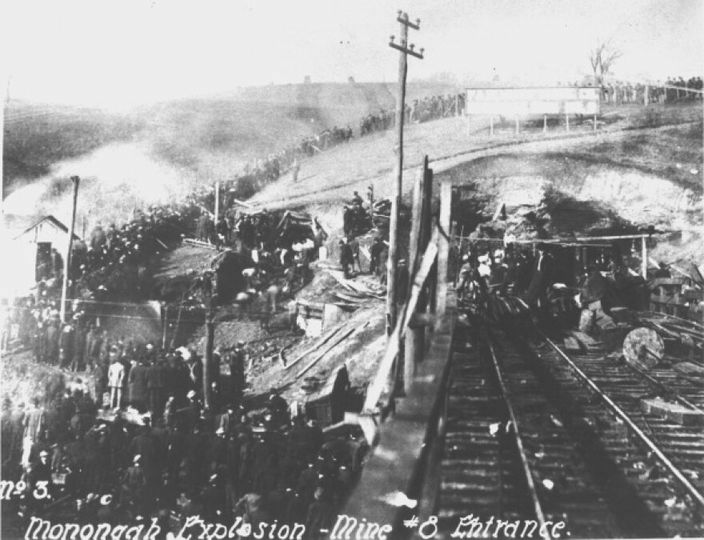
The Monongah Mine Disaster of December 6, 1907 took the lives of at least 362 mine 
workers, many of them immigrants. It was the worst disaster in coal mining history in
the United States.


"The coal you mine is not Slavic coal. It's not Irish coal. It's not Polish coal. It's not 
Italian coal. It's coal."---John Mitchell, President of the UMWA 1898-1908


Around the time that Arnold Miller was becoming nationally known I decided that I would
go to work in the mines as some of my great uncles and others in my extended family had done. I was close to dropping out of school, and working in the mines was all that I could see myself doing. My father, who knew the miner's life, and I had quite an argument about it. The argument ended with me saying arrogantly "I'm going to work in the mines!" and my father saying, "Just stay where you are. I'm going to go find a heavy object and kill you and save the company the trouble." I waited until after my father passed on to get my mining papers.


On April 20, 1914 Colorado National Guard troops opened fire on the Ludlow tent colony in Ludlow, Colorado. Striking mine workers and their families were living in the tent colony during one of the most dramatic and heart-wrenching strikes in U.S. history. At least 19 people, including 12 children and 2 women who were associated with the strikers and the union, died that day at Ludlow. This is a photograph of the Ludlow Massacre memorial.


Nimrod Workman - Forty-Two Years (1976)


Afterword

The "Blue Diamond Mines" song may seem like an odd choice to open this post with, but I believe that it captures a feeling of a place and time and allows me to say something about mine workers' cultures. There are plenty of complaints made by mine workers about the union, but in my experience these are complaints about policies or personalities more than anything else, and they're often made from a place of love and hope. Dissent was baked into the union when it was founded in 1890.

I believe that I owe the UMWA for almost everything that I have today, and I feel good about paying my associate dues every year. How and why I'm paying associate dues instead of retired dues is a long story, but life has its twists and turns. I feel especially good when I can support the Black Lung Movement. I'm thankful every day that I have known so many mine workers, had them as friends and family, joined those picket lines, shared time and food and memories with them and their families. They blessed me with their wisdom and humor, blessings that I have not deserved. Regardless of what you think about coal and energy sources and climate change, I'm sure that you believe that mine workers should receive decent pay and benefits and have secure healthcare and retirement systems. I'm sure that you believe in workplace safety and health. I'm certain that you believe that coal communities and former coal communities should not be abandoned and left to fend for themselves.

Please support those Warrior Met strikers. Please support the miner's rights to a fair standard of working and living, to dignity in retirement and to healthcare. Please support the coal mining and former coal mining communities.

Friday, January 20, 2023

Rhiannon Giddens - Build a House (Official Video)

The other day a white woman---a church-going white woman at that---told me that slavery is all in the past and that we have to forget and just go on. I disagree. We're still living with the legacies of slavery, and I encounter many folks who are starting up to fight the Civil War over again.

A company that handles some of my pension money made its foundational money in part on slavery and what slaves produced. The so-called right-to-work laws that prevent people from forming unions have their origins in the southern states and the remnants of the slave-owning aristocracy. For years the low wages and poor working conditions and lack of social services and the lack of justice in the southern states---all the legacies of slavery---formed a low point and caused a downward spiral across the entire United States and we are living with the effects of that still. I live with the memory of legal segregation---it was not so long ago.

It would indeed be great to move on, but that won't happen in the years that I have left on earth. Much water will flow under our bridges before the line moves in the right direction and we have justice here. My worry is that that water will flow mixed with blood.

If you can do some justice and make some peace today, please do it. If you don't have that opportunity, then just please use your time to do some studying and reflect. Think a little about the "house" referred to in the song above. Could that be our country? Do you really want to burn it down rather than share it with others?  

Tuesday, January 17, 2023

JUSTICE AND INCLUSION: FROM ISAIAH’S PEN TO OUR EYES AND EARS---An insightful essay by Russell Arben Fox

Russell Arben Fox has a particularly insightful article out taking up some aspects of his reading of the Hebrew Bible and his reading of the Book of Isaiah. At one point in his essay Fox says

The Book of Isaiah has, of course, been heavily proof-texted and read selectively by Christians for centuries. No other set of Hebrew poetic and prophetic texts that made their way into the canonical Old Testament have had as massive an impact on how Christians, from ancient to modern times, articulated the faith which the recorded statements of Jesus and the accounts and letters of his early followers inspired. It’s not just that Jesus himself is shown in the Christian Gospels to be quoting from or referencing Isaiah more than any other older text besides the Psalms; it’s that Christianity’s entire cultural and theological approach to and interpretation of Jesus’ message and meaning comes through a heavily Isaian lens–the language of Handel’s Messiah being just the most obvious example. (And with the commemoration of the Messiah’s birth just a couple of days away, this seems like a good time to revisit the text.)

Separating myself as a reader from that inheritance was no easy feat, and I can’t say I was entirely successful. Thanks to Alter’s translation, however, a couple of key ideas were made profoundly clear to me. First, that from its beginning, the book of Isaiah–far more than those associated with any of the other Hebrew prophets–is a text that presents calls to social justice on the same level as its condemnations of the cultic failures and ritual sins of Israel. Isaiah 1:14-17 sets the theme for the entire text, with its explicit condemnation of those who hypocritically attend outwardly to religious duties but ignore the needs of those who are part of that same religious community.

I want to recommend this short essay particularly to my Christian friends who spend much time in the Hebrew Bible and challenge them to read this carefully.

Hazel Dickens


The Hazel Dickens Memorial Bridge is on County Route 11 running over the Bluestone River near Montcalm, West Virginia.


She is buried in Princeton, West Virginia.


She lit up my life and the lives of so many others. I really do miss her.


West Virginia My Home


Beautiful Hills Of Galilee


They'll Never Keep Us Down

Monday, January 16, 2023

"We don’t need museums, we need a movement."

Bishop William Barber speaking to the Guardian on Martin Luther King, Jr. and organizing and mobilizing people today:

“He (Dr. King) was telling us when he died that the greatest fear of the southern aristocracy was the coming together of the poor masses, Black and white. Far too many people never heard that, so they stop at the March on Washington...It’s like turning civil rights into a museum. We don’t need museums, we need a movement. The only way you honor your prophets is when they fall, you pick up the baton and walk the next mile.”

Labor leader Bill Lucy talks MLK and the 1968 Memphis Sanitation Workers Strike


Freeing God to be God--Rev. Graylan Scott Hagler

There are so many opportunities available to honor Dr. King today that I hesitate to lift up a particular one or to put forward anything that might compete with others. But I think that I did find one short essay that has something to say to many of my good friends. It it called Freeing God to be God and was written by Rev. Graylan Scott Hagler, an ordained miniter in the Christian Church (Disciples of Christ) and the United Church of Christ. Rev. Hagler currently serves as the Senior Minister of Plymouth Congregational United Church of Christ in Washington, DC. He helped lead the fight against payday lenders there, and he helped co-found the Neighborhood Assistance Corporation of America (NACA). He is also Director and Chief Visionary of Faith Strategies, LLC, a collective of clergy manifesting progressive perspectives on human and civil rights in the public arena.

Part of Rev. Hagler's essay contains the following. The entire essay can be found here.

During the pandemic, and under Trumpism, a racial split emerged in the evangelical movement as white evangelicals largely supported the policies of Trump; many of those policies clearly racist, and communities of-color, in general, were horrified at the antics of Trump and the lack of criticism from white evangelicals against those policies and antics of the Trump administration. Racial and ideological cracks were revealed where one perspective supported a political/religious orthodoxy and the status-quo, right or wrong, leaving of-color evangelicals horrified and surprised by the racist theological and ideological gap! The white evangelical community went as far as creating a religious litmus test over not wearing a mask during a pandemic, while Blacks and people of-color were disproportionally infected and died from the virus. This revealed at least two separate theologies. There is the theology of the political status-quo, governments, flag-waving, that believe that political leaders are the appointees of God, that slaves should be obedient to their masters, women are kept silent, and statements of American exceptionalism abound. On the other hand, people of-color continued to look to God for freedom, dignity, protection from the hatred and racism of the society, and to maintain hope and a sense of worth amid a hard and unwelcoming world. At least two Gods were revealed, two theologies, two ideologies, and at least two experiences that heard and perceived God in very different ways.

Friday, January 13, 2023

Rabbi Zev Wolf of Zbarazh, Complicity, Representation, and Justice

Martin Buber's wonderful book Tales of the Hasidim may have slipped out of fashion but it deserves to be widely read and become popular once again. It matters much less to me that the stories may be incomplete or more the product of Buber's expansive mind than taken in full measure from the Hasidim or the Hasidic communities. Reading Buber's stories today we want to interrupt with good and necessary questions about Hasidic prejudices, racism, and misogyny. But we also have to let many of the stories speak gently for themselves and take what is best in them into our hearts. The strength of many of these stories is their ability to touch the heart, open its doors, and move in. 

There is one story from Buber's collection that recently came to mind. The story concerns Rabbi Zev Wolf of Zbarazh, his wife (whose name we are not given), and a young servant (also nameless) employed in their home. Rabbi Wolf's wife had a quarrel with her servant over a broken dish. She wanted the servant to pay for the dish, the servant refused, and the argument became rather heated. The rebbetzin decided to take the problem to the court of arbitration of the Torah. She quickly dressed in order to meet with the rav of the town, the rabbi who could competently decide between her and the servant. Rabbi Wolf saw his wife preparing to go to the court and also dressed in his sabbath clothes. 

The rebbetzin protested that it was not fitting for him to go to court and that she knew what to say and how to make her best case without him present. Rabbi Wolf responded, "You know it very well, but the poor orphan, your servant, in whose behalf I am coming, does not know it, and who except me is there to defend her cause?"

This story came to mind because I discovered that a local institution that I take part in uses a law firm that helps evict people, defends corporate clients against charges of sexual harassment, and opposes unions even as that institution tries to help the houseless population and is good on civil rights issues. On the advice of this law firm the institution has moved to contracting with people to provide certain services and will no longer have these individuals on the institution's payroll. A local leader in that institution grew up in a hard-pressed union family and knows something of the dynamics of class struggle.

If you read this blog regularly you will know that my values run very much against what this law firm supports. I'm struggling with how complicit the institution that I take part in is with this firm's terrible work and how complicit I am in all of this. Am I contributing to an institution that works, directly or indirectly, against my own values? If I am, how do I respond?

We can take these issues one by one and argue over them. Maybe there are somewhere terrible tenants who refuse to pay rent and wreck their apartments, maybe someone somewhere has filed sexual harassment charges out of malice, and I know that some people would rather be contractors than direct hires. Unions sometimes drop the ball, and not all union staff and leadership are fully competent all of the time. The exceptions should not make the rules, but those are other matters to take up elsewhere. My guiding point here is that people of faith should consider Rabbi Wolf's example. Defend everyone, even the guilty, against those in positions of power, take dramatic action when necessary, and contradict or shame those in positions of power for the sake of the weak ones and the oppressed. Take the long view and go to the roots of the problems at hand with liberation and salvation in mind.

Thursday, January 12, 2023

Two contrasting images


The couple above were living in their home on the Bayou Bourbeaux Plantation in Natchitoches Parish, Louisiana in 1940 when this photograph was taken. The plantation was then operated by the Bayou Bourbeaux farmstead association, a semi-cooperative established through the auspices of the Farm Security Administration. The photograph was taken by Marion Post Wolcott for the Farm Security Administration. Zoom in a little on the photograph and you will see that these are hard working people and that the man has a half-smile and that the woman and the child have that apprehensive look of people who are not used to being photographed. The child appears to be playing, or they are not working.

Natchitoches Parish has a history of free people of color, Creole, and mixed-race settlement. It is set in the historic Black Belt.


The photograph immediately above was taken in Greene County, Georgia and is also a Depression-era photograph. I do not remember who the photographer was, but I'm certain that this was also a Farm Security Administration photograph. I remember reading that this man was a plantation owner and this his operation had been in his family for many generations and that his property was heavily mortgaged at the time that this photograph was taken. He stood to lose everything that he had, I suppose.

I don't know much about Greene County, and the histories of working-class people, African Americans and Natives Americans there have not been recorded. I believe that the county has seen a loss of its Black population in recent decades.     

What stands out for me here are the different experiences and legacies captured in these two photographs. Those plantations were on stolen land. There remain the legacies of forced colonialism, slavery, the Civil War and Reconstruction, the changes that took place in the southern agricultural economies that increased production and caused dispossession of so many people, and the Great Depression. But the couple in the photograph have something to smile about and just a bit of security while the plantation owner who is facing the loss of ill-gotten generational wealth and public humiliation is clearly worried, and perhaps angry as well. The couple and their child do not stand in for all Black people, and neither does this worried and angry man stand in for all whites. The four of them are victims of a system, but they were experiencing their lives quite differently at the moments when these photographs were taken.

Semi-cooperative and cooperative agriculture would not solve every problem faced by farmers and tenant farmers. It will not, by itself, take up the questions of the theft of land and the genocide of Native American and Indigenous peoples. Restructured semi-capitalist or non-capitalist forms of agricultural production will not guarantee equality or security. No one said that they would. But I can't help but think that the plantation economy was bound to fail, and should have done so, and that semi-cooperative and cooperative government-sponsored agricultural programs had a necessary role in building up alternatives to the old ways. And within those alternatives greater possibilities were presented and made possible.

The tragedies that attended these programs were that they were not carried out to in greater scale and did not last longer and prevail against the old political and social systems. We are still fighting the hold-overs and hold-outs of the old planter aristocracy, and the threat of civil war is once again in the air. It is to our lasting shame that we have not yet found the ways to bring poor and working-class people of color and poor and working-class whites together in one mass movement to create good and lasting change.

Would you rather be the hopeful family with a chance at doing better with and within your community or the lone worried and angry man in the rocking chair?


Wednesday, January 11, 2023

Elliott---Rest In Peace

The fellow below is Elliott. I don't know much more about him than his first name, that he was houseless and struggled with some kind of substance abuse disorder, that he lived on streets in the town that I live in, and that he died last Friday.

I say it often on this blog---he was somebody's son. Regardless of what he got wrong in life and struggled with, he was a human being. He was one of us. I pass houseless people every day and try to provide what I can when I can, but there my solidarity stops. I feel helpless, and it hurts to think that I am complicit in anyone's suffering. Maybe you feel the same way. I carry an added burden here because I have spent so much time in my life struggling with my own demons and getting so much wrong. You would think that someone in my situation would do more and do better.

The philosophical and practical question of the day is this: are we worthy of those who we cause to suffer, either by our actions or through passivity? Is the story of Lazarus a fable or does it have meaning? We have so many warnings. Why aren't we listening?


A family member wrote: "I want to say thank you to all those people who have helped my brother Elliott out while he was in your community. He was homeless and it sounds like commercial st was his area. I’ve ready so many loving stories of people who helped him in many ways. I appreciate you all. He made choices and lived his life how he saw fit. He passed away Friday. I just wanted to say thank you for knowing everyone out there is someone’s son or brother. We tried many ways to get him help, he chose what he chose and we still loved him. This was him clean and sober an Easter Sunday 6 years ago. We will miss him." (Advocates For Unsheltered Of Salem)  

Sunday, January 8, 2023

Why would "religious people" ever protest something in Washington, D.C.?

Sometimes people hear about protests and wonder how they happen or why, and they don't understand why "religious people" would go to certain protests and even get arrested at these events. For the people of faith who go to the demonstrations this is all about providing a living witness of and for their faith and making a statement of some kind. It often feels to me that the two groups don't talk to one another, and maybe even avoid doing so. The folks scratching their heads and wondering what's going on and the activists do have much to talk about, though.

The Rev. Nathan Empsall, the Executive Director of Faithful America, explained some of this in the following e-mail the other day:

For many Western Christian traditions, today is Epiphany -- the day the magi arrived at Jesus's manger.

More than 2,000 years ago, these wise men experienced the epiphany that this child was the Christ: the Prince of Peace, the Son of God, and the expected Messiah. The magi then stood up to political violence by thwarting the oppressive King Herod's attempt to kill the infant Jesus.

Just two years ago, religion met with political violence once more on January 6, 2021, when thousands of Proud Boys, Oath Keepers, and other Trump supporters stormed the United States Capitol in the hijacked name of Jesus, convinced that their efforts to destroy democracy were divinely authorized.

That's why early this morning, I joined with dozens of diverse Christian leaders outside the U.S. Capitol to pray, and to offer a Christian witness for peace and democracy. At the "Sunrise Prayer Vigil for Democracy" -- co-organized by Faithful America and our friends at the Christians Against Christian Nationalism initiative -- we denounced Christian nationalism and white supremacy; prayed for healing for every person on Capitol Hill who relived trauma today; and spoke out for the values of love, democracy, and freedom for all.

As the sun rose over the Capitol and darkness turned to light, we felt not only the dawn of a new day but also the hope of the resurrection -- and the promise that together, we will build a better future.

A video and some photographs were provided so that readers could see what took place on January 6. Rev. Empsall's e-mail went on to say:

Today, I prayed that God would grant a new epiphany to those who follow Christian nationalism, and show them that where Christian nationalism spreads violence, hatred, and misinformation, Jesus teaches us peace, love, and truth.

Others who spoke included the Rev. Dr. Cassandra Gould, who prayed, "We come this morning, God, because the blood of our siblings continues to cry out from the ground not just from two years ago today, but from the very founding of this country… We come this morning to say that time is up for white Christian nationalism."

We also heard from evangelical author Shane Claiborne, who said, "Christian nationalism is a perversion of the Gospel of Christ… We call out the principalities and powers of racism, xenophobia, fear, and white Christian nationalism, and we declare that your love triumphs over them."

We appealed to God to give us strength for the work ahead, and also showed journalists and lawmakers that where Christian nationalism seeks to strip away the rights of everyone but conservative Christians, Jesus calls us to build shared power and freedom for everyone, regardless of race, religion, zip code, physical abilities, gender identity, or sexual orientation.

And to learn more about Christian nationalism, visit our new FAQ + Resources page.

Today's vigil featured friends and allies from local Baptist congregations, the National Council of Churches, Red Letter Christians, Sojourners, Faith in Public Life, Faiths United for Democracy, NETWORK Catholic Lobby, Catholic Vote Common Good, Faith in Action, the Interfaith Alliance, authors like Jim Wallis and Jemar Tisby, and so many more. We at Faithful America are so grateful to everyone who turned out to pray -- and who takes concrete action grounded in that prayer.

Wishing you a peaceful and blessed Epiphany season,

- The Rev. Nathan Empsall
Executive Director, Faithful America

If you read up on the issues mentioned here and think about where the United States is at right now you will probably agree that this is pretty important. I want to encourage you to check out Faithful America and some of the organizations mentioned above. 

Saturday, January 7, 2023

Every boy and man needs to hear this loud and clearly

This is one of those posts that I don't want to fall on deaf ears. I don't want men to forget this. Years ago I heard a woman trying very patiently to explain to a man how different it made the two of them that she had to carry her keys in her hand or a whistle with her when she left work and walked to the parking lot at night or had to walk to her car alone after shopping. The guy just didn't get it. Men need to hear this. Every boy and man needs to hear this.


Wednesday, January 4, 2023

Charlie Stephens: Giving Back Indigenous Land

My friend Charlie Stephens put together this important opinion piece about how they and their partner made the decision to turn over or return a parcel of land---36 acres---to tribes in the Sierra Foothills of California. The piece ran on the KQED radio station in San Francisco yesterday. You can hear and read the piece by going here or you can read it below. The questions of land and land ownership are basic to any people's freedom, but those questions do not stand alone in the cases of Indigenous peoples given the histories of settler violence, government control, and dishonesty that, when taken together, are genocidal. This powerful article should give readers pause to consider what we can all do and if we're brave enough to make the kinds of decision that Charlie and their partner did.


So much land was stolen from Indigenous peoples over much of American history that the debt can never be repaid. But Charlie Stephens decided he would do what he could to make amends.

In 2016 my partner and I bought 36 acres of off-the-grid land in an area of the Sierra Foothills covered with pine, madrone, cedar and oak. We were greeted by owls, bats, deer, bobcat, and hawks, and by clear night skies and air that smelled sweeter than what we breathed in our Berkeley neighborhood.

In 1862 under the Homestead Act, Indigenous land was parceled out and sold to white homesteaders for as little as $1.00, in exchange for agreeing to fence in the land and keep Indigenous people off it. About 270 million acres of land was stolen under this policy. Between 1906 and 1910 California’s Rancheria system provided land to Indigenous people not living on reservations but then just as quickly took it away (yet again) as Congress terminated this agreement in 1958. The Williamson Act of 1965—still in existence today—continues to perpetuate these issues.

This winter we will be giving these 36 acres back to the tribes for a symbolic $1. The land will be stewarded for conservation and cultural practices, bringing together elders and youth to harvest traditional plants for ceremonies, to care for the land with each other, and to have “back” what never should have been taken.

The tribal member we are working with said the last time someone offered to return land in this area was when he was three years old, and that it fell through at the last minute, echoing the historical failure of white promises.

Talking with him, I started to imagine the return of Indigenous land as a more common process, that here in California and beyond, donating land might outweigh amassing and protecting personal wealth. Soon this land we have loved will be back in the hands of the people who should have had it all along. I encourage others to consider doing the same even if it requires some financial discomfort or loss. As Martin Luther King, Jr. once said, “The time is always right to do what is right.”

With a Perspective, I’m Charlie J. Stephens.

Charlie Stephens is a writer, educator and bookstore owner.


Some things to do, some things to smile on, some things to ponder


"The mountains are my bones, the rivers my veins. The forests are my thoughts 
and the stars are my dreams. The ocean is my heart, its pounding is my pulse.
The songs of the earth write the music of my soul."


"I sing because I'm happy. I sing because I'm free, His eye is on the sparrow
and I know he watches me."