Showing posts sorted by relevance for query virginia lee. Sort by date Show all posts

Wednesday, May 4, 2022

"Never lose an opportunity of seeing anything beautiful, for beauty is God's handwriting."---Part Two

This is the second of a two-part series. Read Part One Here.

Now I want to ramp things up a little.

I don’t know Ms. Virginia Lee or that wonderful-looking couple she took photographs of recently, but I do wish that I knew them and lived close by them. There are scores of stories in her photography. Virginia Lee is self-taught---you would not know this from looking at her work---and what comes across most to me as I look at her photography is that there are real people there, that she’s standing at a line between documenting people’s lives and giving them and their families something to hold on to. She’s documenting people’s lives even when they dress up and pose because that’s part of life and there is a story behind that photograph of how they got to that point and what it means to them.


And there is more. In these photographs you see a handsome mine worker after work, a loving couple, and a beautiful woman. You also see a contrast between work and something else---but what is that “something else” that holds your gaze? There is wisdom, hope, and faith in the unknown there. Virginia Lee is showing a kind of contradiction between two forces, but she’s resolving that contradiction by showing abiding love. I friended the woman in the photographs on Facebook and I see that she is a healthcare worker in West Virginia and that she’s full of commonsense, has strong ties to her family and her community, and will stand up for what she thinks is right. So, whatever the story of romance and love that we’re seeing is, we’re also seeing a story of modern-day Appalachia that contradicts every stereotype that is out there.

Where does this self-taught art of creatively bringing forward beauty and stories come from? Ms. Lee wrote me that she lives and works “in the coalfields in SouthWest Virginia.... Tazewell County, Richlands VA......right on the border of WV.” and that she “had many coal miners in my family and I'm originally from McDowell County, WV.”. So here again we have someone creating from what they know and evidently love, treating their place and people with respect and compassion and reminding the world of our shared humanity. You can visit with her at https://www.facebook.com/vleephoto and maybe arrange for her to do some work with you. I hope that you will.

I have a box full of photographs of family members and their friends that were taken 70-110 years ago, mostly all unsmiling people who were weighed down by work and daily struggles or who just weren’t used to having their photographs taken. They’re even wearing long dresses and suits on the beach. My grandmother, her father’s favorite of 7 children, stands with her hand on her father’s shoulder, the family stiff and formal except for the impish look in my great-uncle Max’s eyes in one family photograph. My great-aunt Celeste is almost gaunt, just a slip of a girl who looks hungry and needy. What saves this photograph from being just another slightly-out-of-focus photograph of a coalfield family is that the photograph was taken after a long strike that the mine workers mostly won and that everyone in the photograph except my grandmother would have nearly impossible and difficult lives and die way too young.

A few years back I went to another country knowing that I was stepping into a dangerous political situation. A friend of mine and I went to a professional photographer before I left because I wanted to record something in case I didn’t make it back. When we look at photographs of mine workers and healthcare workers, we need to remember the dangers of their jobs and we need to celebrate the joys they’re capturing on film. I wish that a Virginia Lee had been around 100 years ago. We need the Virginia Lees. They’re a blessing to us.

I want to say a good word before I close about the Reconnecting McDowell organization because we always need people helping people in the Appalachian regions, that area where all of the good people mentioned above live and work and call home. The official description of Reconnecting McDowell is that they are “a comprehensive, long-term effort to make educational improvement in McDowell County the route to a brighter economic future. Partners from business, foundations, government, nonprofit agencies, and labor have committed, in a signed covenant, to seeking solutions to McDowell’s complex problems—poverty, underperforming schools, drug and alcohol abuse, housing shortages, limited medical services, and inadequate access to technology and transportation.” 

They have lots of projects going on: 

·         GoGrowcery—a mobile farmers market that takes local produce to various stops in this 535-square-mile food desert

·         Broader Horizons—a mentorship and experiential learning program for high school juniors that helps them navigate the post-high school world and takes them on trips to Charleston and Washington DC

·         Make it Shine McDowell—our countywide litter cleanup program with a coalition membership including everyone from Wobblies to Mormons

·         Maier Scholarships—presented to selected high school graduates so they can attend higher ed in WV

·         Early reading initiatives—book giveaways, working in schools, working with other groups to provide reading materials, especially during the summer

·         Friends of the Tug Fork River—a watershed group we helped form to improve water and make the river available for recreation and economic development

·         Music programming—hosting events at the Caffrey Arts Center featuring a combination of local and regional talent

·         Wrap-around services in schools—including Smiles, a program for dental care, and work with the Communities in Schools Initiative

·         Renaissance Village—our new building, the first commercial structure in Welch in more than 50 years


I like all of that, and I’m feeling good that I sent Reconnecting McDowell a contribution today, but I also know a guy who works there who I think is just one-half-step this side of the angels. I know that Reconnecting McDowell recently organized a trash pick-up, and I know that that may not sound like a big deal. But try thinking about it this way: people throw trash out of their cars or dump garbage by the roadsides and in the hollers because they no longer feel ownership of their place or responsibility to their people and their environment. We call this “alienation.” So, when people do the opposite and do take responsibility for their communities and environment something good is happening. Something big is taking place. A spirit is moving in the land and in the people.

Think about those folks dumping trash with this in mind:


The history that Joe Mullins and the Radio Ramblers, J.R. Shuck, Ms. Virginia Lee, and that good-looking couple above show us isn’t half-done yet, although it took 300 million years for that beautiful black coal to form. Every day we have a choice to make about going forward or backward, and I believe that Reconnecting McDowell, Appalachian Voices, the Black Lung Association, the United Mine Workers of America, radio station WMMT, the Appalachian Citizens' Law Center, The Mountain Eagle, and other similar efforts are blessing us with their work and presence and shining their headlamps in the right direction.

Wednesday, August 17, 2022

“The camera is an instrument that teaches people how to see without a camera.”---Dorothea Lange


Well, here I go again. I have said it before: a person can talk day and night on something they know nothing about, but ask that person to talk about something that they do know and they will run out of talk in about 15 minutes. That and I always say that experts are just people far from home. If the people that you grew up around heard you advertising as being an expert, they would just die laughing. Here I am going on.

Now, on May 4, 2022 I did two posts here about art and photography in Appalachia. They are titled "Never lose an opportunity of seeing anything beautiful, for beauty is God's handwriting---Parts One and Two.” They were not particularly well written or profound. My point in writing those posts was to talk about painting and photography, and about some painters and photographers as people who not only document or record life as it changes, but also as people who we informally appoint to tell us and others more about ourselves and our experiences. They become our representatives to a larger world.

Every time you turn on the radio or the tv you hear someone talking from a particular place and a particular viewpoint that is shaped by their experiences and who they’re representing. I’ll wager you that in a day of listening to the mainstream tv or radio you won’t hear any working-class people telling our stories the way we tell them or would like them to be told. It’s not the fault of the media; their sponsors and their mindset don’t allow for us to be much more than consumers or victims or rough people. We know that we’re more and better than that, but sorting that out is hard if we don’t have the means to do that.

That’s why the painters, photographers, singers and bands, poets and writers, carvers and whittlers, cooks, storytellers, six-time-mommas who still tell bedtime stories, and so many other creative people who come from the working-class are so important. If you can find something of yourself in their work you might be on the way to sorting out your life essentials---where you came from, where you want to go, how you want to get there, and who is coming along with you. This helps people break out of their bad sides and start getting along with others, and who knows where that will stop once it takes off?

If you know where you have been and you get a vision of where you want to go, you’re more likely than not to start loving the people around you. Most of us want for others what we want for ourselves most of the time and you can’t care for yourself without caring for others. Life doesn’t work that way. You’re more likely to put down that bottle or that joint or the meth because, well, at some point it’s either that or it’s your future and it's either that or the people who care for you.

I tried to make the point in my May 4 post that I think that Kristen Kennedy, the woman who does the photography at Virginia Lee Photography in southwestern Virginia, is one of those people who helps us sort ourselves out. Her work gives me a good push on most days because I can see myself or people who I come from in her work. You can catch up with Virginia Lee Photography on Facebook, and if you live in Central Appalachia, I hope that you will make an appointment with her and get some photography done.

But how is she documenting people, and what does her work have to say to us? Some things are subtle. You have to let them sink in over time. A photograph is usually something more than a picture. The person or place that you see when you look at a photograph is held there at a particular moment. Yesterday they were different, tomorrow they will be different. It’s good to ask yourself how they happened to get there and where they’re headed. Ask yourself those questions, too.

I’m going to focus here on Appalachia, big and diverse as it is, and certain rural areas. You can be Appalachian and be in Northeastern Pennsylvania or in parts of Alabama. You can live in a holler or a patch or in a city. You can use yellow, white, or blue cornmeal. Your family’s roots can be in any part of the world. My grandmother would say that labels are only good for cans of soup.

Once, not so long ago, we looked a lot like this:


We were mostly poor, and many of our people were undernourished. Our families lived in rural areas, coal patches and hollers, “across the tracks” in towns and cities, in segregated and “ethnic” neighborhoods. 

And many of our families lived in homes that looked like this:


And when we look at the Virginia Lee photography this is some of what we see:


Now, what changed? How is it that, with all of our troubles, many of us look healthier and happier today then we used to? Some of it is color photography. Some of it is that today people smile in the camera. Some of it is that people go to Virginia Lee Photography to have a happy occasion photographed. But it’s also true---and this is central for me---that between those old times and today lots of people stuck together, showed love to one another, and made positive change by protesting, going on strike, and fighting for better living conditions.

Freedom is a continuing struggle, but we have had victories. Most kids in the United States don’t go to work in the mines and factories now. We have mine safety laws. We have seen times in this country when we had majorities or near-majorities of people who believed in peace, civil rights, union rights, and policies that put people ahead of profits. Appalachia and many rural areas were key to those movements.

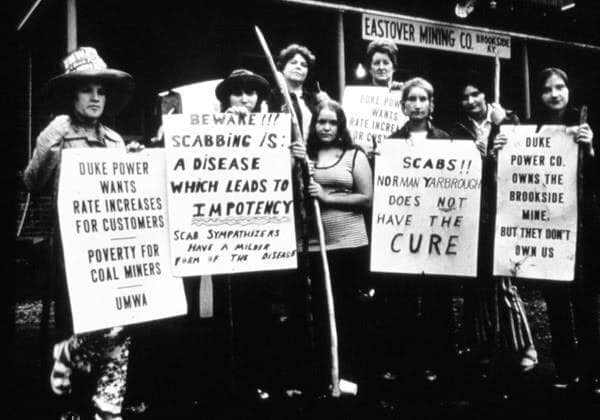
From the film "Harlan County, USA"


From the film "Harlan County, USA"

Please take another look at some of the work done by Kristen Kennedy with what you have read above in mind.


The sentimental person within me says that this love and joy did indeed fall from the skies. But another voice tells me to take a minute and reflect. Do you see an evolution here or cause-and-effect? Where do you see the evolution and the change? I see it in the means of doing photography itself and in the very bodies and faces in the photographs, but I also see it in the development of real human feelings. The protests and the movements for change have expressed something good in people, but they also helped those feelings to find expression. The proof that these movements succeeded to some extent is in the smiles that you see here and in the faith needed to have a child or graduate from school today. And Kristen Kennedy is there to capture that love and joy and represent us.

Sources:  The photographs here and other work done by Kristen Kennedy can be seen at the Virginia Lee website and on the Virginia Lee Facebook page. Some of the photographs above come from my family album. Most of the photographs here have ended up on my desktop over the years and come from sources that I can't trace. Mr. Bob Wilson and the Appalachian Americans, Scenic Harlan County, and Forgotten Coalfields of Appalachia Facebook pages are good sources. One of my best and favorite sources is the Pine Mountain Settlement School Collections. If you are fortunate to find the work of Marat Moore anywhere, snap it up.   

Wednesday, November 16, 2022

For smiling on and thinking about


Taken from Virginia Lee Photography. Have you seen a sweeter photograph?


This photograph also comes from Virginia Lee Photography in Southwest Virginia. This really speaks to me, and I hope  that it speaks to you as well. let's support our young families, and let's also support the creative people in our communities. If you're in the region, please connect with Virginia Lee Photography and see if you can't get some creative work done with them. 


My copy of this marvelous photograph by Rick Burgess of the stars and sky at Dolly Sods Wilderness in Tucker County, West Virginia doesn't do the original photograph or the place and moment justice. Please find Rick Burgess on Facebook and take a look. This is an image of peace and reassurance for me. May it be the same for you.


I'm trying to break down the idea that adults can't have softness in our lives. This photograph came from a Facebook friend and has some sadness attached to it, but my point is that maybe you didn't get a soft touch as a kid and maybe you want it now, or maybe it's just a time in your life when you need that. Go ahead. Do it.   


“There is something fundamentally wrong in treating the Earth as if it were
 a business in liquidation.”
— Herman Daly, “Steady-State Economics” (1977)


Sunday, January 1, 2023

Some of the beauty around us


Snow on the creek. Clay County, KY. Photograph by Tony Kidd posted on
the Appalachian Americans Facebook page.


Ice on Big Pine Creek, North Madison County, NC.


Alan Felts


Alan Felts


Kristen Kennedy/Virginia Lee Photography


Kristin Kennedy/Virginia Lee Photography